
Expedition: Saving Our Seas began its announced streaming window on Disney+ and Hulu on November 14, bringing National Geographic’s new ocean documentary to home viewers after its November 13 television premiere. Narrated by Auliʻi Cravalho and directed by Katharine Arthy, the special follows research across all five ocean basins. Its entertainment story is the screen arrival of an ambitious factual production, built around real expeditions and the technology that allows distant underwater worlds to be filmed. [1][2]
The broadcaster’s October 14 announcement, carried by ABC Updates’ Jim Donnelly, established the release plan and production credits. Offspring Films produced the special for National Geographic. The listed executive producers include Sam Hodgson for Offspring, Vanessa Serrao and Kaitlin Yarnall for the National Geographic Society, and Tracy Rudolph Jackson for National Geographic. The project is presented by the Society in partnership with Rolex as part of the Perpetual Planet Ocean Expeditions. [1]
The streaming page identifies the film as TV-PG and lists a 44-minute duration. National Geographic’s television page gives the more precise program length as 43 minutes and six seconds. Those figures fit the announcement’s description of a one-hour television special: a broadcast slot and the running time of its program are different measures. The short format is important because the film attempts to connect projects spread across enormous distances. [2][3]
Carolyn Gramling’s November 14 Science News review provides an independent account of that structure. She describes a film organized around the connections among the ocean basins, moving among research teams rather than staying with one expedition throughout. Her review also notes the limited time given to each project. That is useful critical context for a viewer deciding what kind of documentary to expect: a linked survey of active work, rather than an exhaustive account of a single study. [4]
One of the major settings is the Southern Ocean. The National Geographic Society’s expedition record dates the relevant Weddell Sea research to December 2024, conducted in collaboration with the Schmidt Ocean Institute aboard the research vessel Falkor (too). That chronology matters. A newly released documentary can present work filmed much earlier; the November streaming date does not mean every discovery shown occurred this weekend. [5]
The Society’s record identifies first observations and samples from the expedition, including a live sighting of the Antarctic gonate squid. The program announcement describes scientists using the remotely operated vehicle SuBastian to examine deep environments. Those are two complementary records: one establishes the research expedition’s work, while the other explains its place in the documentary. Neither should be used to imply that a narrated sequence was recorded at the same moment as the final narration. [1][5]
For FanFest’s analysis, an underwater research camera has a dual role in a production like this. It provides images an audience can experience visually, but it also records material scientists can inspect and compare. The dramatic appeal comes partly from that shared uncertainty: the people looking at the monitor may not know what will enter the frame next. Editing can organize the experience, while the observations retain a purpose beyond the finished film.
The Arctic material offers a different example of how an expedition is assembled. The University of Manitoba’s August 22, 2025 account identifies oceanographer Kristina Brown’s work in Sherman Basin, in the southern Canadian Arctic. It describes research aboard the Arctic Research Foundation’s Martin Bergmann and collaboration with the community of Gjoa Haven. That institutional history supplies background for the same region’s appearance in the new screen project. [6]
National Geographic’s Devin Gordon explored the work further in an August 28, 2026 feature. His account explains the practical challenge of reaching waters without established marine charts and describes the basin’s shape as a factor in its abundant marine life. Tidal mixing can bring nutrients into layers reached by sunlight. The article also records the involvement of local youth and Elders, giving the research a history broader than the visiting scientific team alone. [7]
That background makes the documentary’s emphasis on collaboration concrete. Local experience can influence where researchers look and what questions they ask. Scientific equipment can then produce another kind of record of the same place. In storytelling terms, those contributions give an expedition more than one perspective: the destination is a working environment and a familiar home as well as a location for new measurements. That observation follows from the documented partnerships, rather than an invented scene or conversation.
The film also connects large expeditions with smaller imaging systems. In its November 10 announcement, the Ocean Discovery League confirmed that founder Katy Croff Bell and the Maka Niu and DORIS technologies feature in the documentary. The organization says Maka Niu cameras were used in The Gambia and Nunavut, with lessons from that work informing DORIS. It records the newer system’s initial test deployment in Monterey, California. [8]
DORIS stands for Deep Ocean Research and Imaging System. The League’s technical page describes an untethered modular camera system designed for depths of 6,000 meters, with a target base price below $10,000. Its planned components include camera and lighting modules, environmental sensors and data logging. Those are the developer’s stated design goals and specifications, not a claim that every unit is already available commercially at that price. [9]
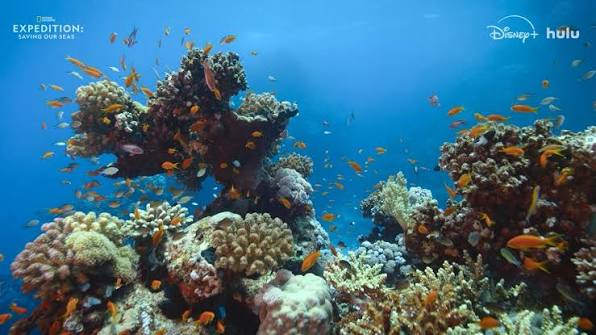
The distinction between a tethered remotely operated vehicle and a compact untethered instrument helps explain the variety of images an ocean documentary can contain. Different systems serve different research situations. A vehicle operated from a major ship can be directed during an observation, while a smaller deployed camera is designed around another set of constraints. The film’s technology story concerns the tools that make observation possible, rather than a single camera solving every underwater problem.
Cravalho’s narration provides a recognizable voice across that changing set of places and people. The official credits establish her role, while the listed director and production company identify the team responsible for shaping the material into a program. A narrator can link locations and explain transitions, but the research teams and recorded environments remain the documentary’s subjects. Its production combines authored storytelling with work that began before the final film took shape. [1][2]
The new availability gives viewers a concise route into those expeditions, with the deeper institutional records available for anyone who wants to follow a particular project. Saving Our Seas arrives as a completed, credited special with a dated television and streaming rollout. Its most substantial appeal is the access it offers: cameras entering difficult environments, researchers interpreting what they find and a filmmaking team connecting those discoveries into a journey that can be followed from home.
Sources and reporting credits
[1] Watch Expedition Saving Our Seas Premiering November 13 on National Geographic Streams Next Day on Disney Plus and Hulu — Jim Donnelly, ABC Updates carrying the National Geographic announcement. October 14, 2026.
[2] Expedition Saving Our Seas — Disney Plus. Official film listing; accessed November 15, 2026.
[3] Watch Expedition Saving Our Seas Online — National Geographic TV. Program listing dated November 14, 2026; accessed November 15, 2026.
[4] In National Geographic’s Expedition Saving Our Seas It Is All Hands on Deck — Carolyn Gramling, Science News. November 14, 2026.
[5] Ocean Expeditions Seashore to Seafloor and Pole to Pole — National Geographic Society. Official expedition record; accessed November 15, 2026.
[6] Uncovering the Mystery of the Sherman Basin — University of Manitoba. August 22, 2025.
[7] Revealing an Oasis at the Top of the World — Devin Gordon, National Geographic. August 28, 2026.
[8] Ocean Discovery League’s Low Cost Deep Sea Technology Featured in New National Geographic Film — Ocean Discovery League. November 10, 2026.
[9] DORIS Deep Ocean Research and Imaging System — Ocean Discovery League. Undated project specifications; accessed November 15, 2026.
