
Godzilla: Destroy All Monsters Melee Remastered is getting fresh attention after entering Steam’s weekly revenue rankings. ComicBook.com’s Tyler Fischer highlighted the game’s performance on November 14, bringing a new audience to a revival released earlier this month. Valve’s own charts confirm a notable debut, while also showing why the exact ranking needs more explanation than a single number. [1][2][3]
On Valve’s global weekly chart for November 3 through November 10, the game appears at number 17 among products ranked by revenue. On the United States version of that same weekly chart, it appears at number four. These are different geographic lists, not contradictory results for an identical ranking. Both identify the remaster as a new entry in the period. [2][3]
ComicBook’s article describes an eighth-place finish among paid PC games. That narrower framing should not be confused with Valve’s unfiltered global list, which also includes free-to-play games generating revenue, additional game entries and Steam Deck hardware. The primary figures used here are the directly checked Valve positions. A headline about sales is more informative when its territory and chart category remain attached. [1][2]
Valve’s Steamworks documentation explains that top-seller lists are generated from revenue, including base-game purchases, downloadable content and in-game transactions. It also explains the existence of country-specific and global lists. The rankings therefore tell readers where spending occurred relative to other products in a defined view. They do not provide a public count of copies sold for this particular game. [4]
That distinction changes the interpretation of the result. A lower-priced release can attract many buyers without matching a more expensive product’s revenue. A free-to-play title can rank because players spend within it. A regional success can look stronger than a global result. None of those observations diminishes Godzilla’s debut; they clarify the kind of achievement the available chart actually records.
The remaster arrived November 3, 2026, from developer Pipeworks Studios and publisher Atari, according to its Steam listing. Its title refers to the 2002 arena fighter, rather than a newly announced Nintendo production. The current release is a multiplatform revival of a game associated with the GameCube era. Calling it a GameCube remaster describes its history, not its present exclusivity. [5][6]
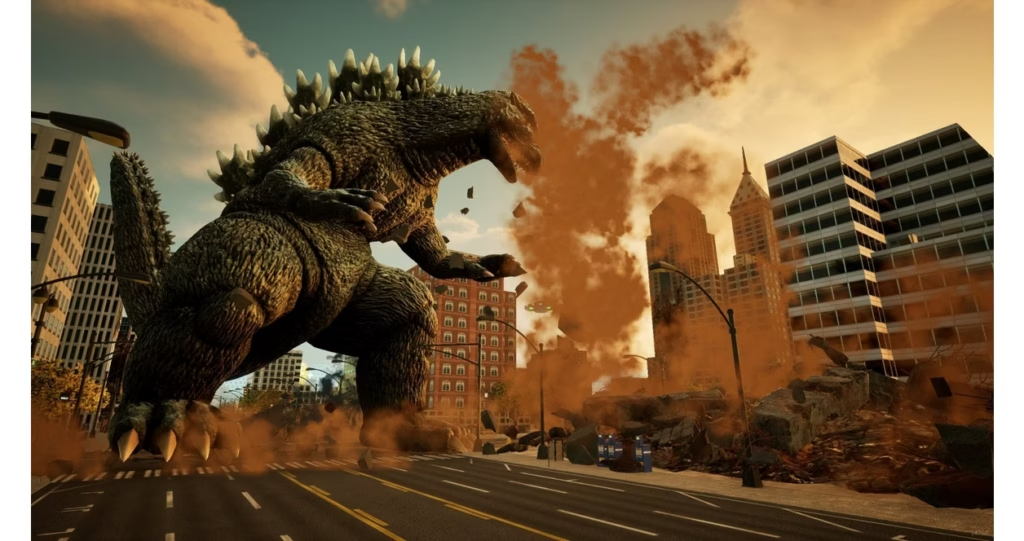
Atari’s product description identifies 12 playable monsters and eight locations, with day and night variations. The locations include city environments, Monster Island and an alien mothership. Each monster has a distinct set of moves, and the environments are part of the encounters rather than merely scenery around them. Those are publisher-described features; this article is reporting them rather than presenting a hands-on review. [6]
The premise translates a familiar screen attraction into an interactive one. A monster movie asks the audience to watch scale, movement and destruction. An arena game gives the player control over position and timing within that spectacle. The design challenge is to make a giant character feel powerful while keeping its actions understandable enough for another player to respond. That tension is central to the appeal of the format.
The current version also changes access to the game’s rewards. Atari describes an improved unlock system allowing players to choose the order in which they obtain monsters, locations and gallery material. For a returning player interested in a particular creature, that matters more directly than a cosmetic change: the route to the desired character becomes part of the experience. [6]
The PlayStation Store listing confirms additional single-player campaigns for individual monsters, alongside local and online multiplayer. Its release date matches Steam’s November 3 date. Separate storefronts can have different account requirements and purchase terms, so the shared launch does not mean every platform offers identical surrounding services. The confirmed point is that the remaster supports more than one way to play its central arena battles. [7]
For a family or a group of friends, local play and online play create different practical settings. Playing together in the same room makes it easy to explain controls and trade turns. Online matchmaking connects a player with people outside that room. The presence of both modes broadens the game’s use, but it does not establish a cross-platform matchmaking feature; the reviewed listings do not supply a basis for that additional claim.
User reviews provide another current signal. When checked on November 14, Steam displayed an Overwhelmingly Positive label, with 95 percent of 1,500 user reviews positive. Fischer’s earlier report cited a smaller review total. That difference reflects the changing snapshot on a live storefront; the percentage and count should travel together with the date on which they were checked. [1][5]
A review percentage is also different from a sales rank. One concerns responses submitted by reviewers; the other concerns spending during a specified period. Neither shows the views of everyone who purchased the game. Taken together, they support a limited but useful conclusion: the remaster has generated meaningful early store activity and a strongly positive response among the Steam users who have posted reviews.
The publisher’s original June announcement established the November release plan and the return of Pipeworks, the original developer. That production continuity is relevant background to a revival of a decades-old game. It does not guarantee that every player’s memory of the original will match the new version, but it makes the project more specific than a familiar license being attached to an unrelated new format. [8]
For PC players, the current Steam listing provides concrete requirements alongside the nostalgic premise. It specifies a 64-bit operating system, Windows 10 as the minimum listed version, 16 GB of memory and 8 GB of available storage. The listed minimum graphics card is an NVIDIA GTX 1650 with 4 GB of video memory. Those requirements are a more useful compatibility check than assuming a remake will run on any computer because its source game is old. [5]
The latest news is therefore the game’s performance after release, rather than its arrival being announced today. Valve’s charts put Godzilla at number 17 globally and number four in the United States for the checked week, while the storefront records a positive early review response. For fans of monster cinema and older arena fighters, those results give a concrete reason to take another look at a game whose appeal begins with a simple invitation: choose a kaiju and step into its oversized world.
References and reporting credits
[1] New Nintendo GameCube Remaster Officially One of the Best-Selling Steam Games — Tyler Fischer, ComicBook.com. November 14, 2026.
[2] Weekly Top Sellers Global November 3 to November 10 2026 — Valve Steam Charts. Chart week November 3–10, 2026; accessed November 14, 2026.
[3] Weekly Top Sellers United States November 3 to November 10 2026 — Valve Steam Charts. Chart week November 3–10, 2026; accessed November 14, 2026.
[4] Top Sellers Lists — Valve Steamworks Documentation. Undated; accessed November 14, 2026.
[5] Godzilla Destroy All Monsters Melee Remastered — Valve Steam store listing. Released November 3, 2026; accessed November 14, 2026.
[6] Godzilla Destroy All Monsters Melee Remastered — Atari official product page. Undated; accessed November 14, 2026.
[7] Godzilla Destroy All Monsters Melee Remastered — PlayStation Store. Released November 3, 2026; accessed November 14, 2026.
[8] Atari and Pipeworks Unleash Godzilla Destroy All Monsters Melee Remastered The King of Kaiju Brawlers Returns This November — Atari announcement via Games Press. June 6, 2026.
