
Anthony Ippolito spoke with Sylvester Stallone about a month before filming I Play Rocky, adding a firsthand conversation to months of preparation for playing the actor and screenwriter. At Deadline’s Contenders Film Los Angeles on November 14, Ippolito described hearing Stallone reflect on the circumstances that led to Rocky. It was a new account of the research behind a performance built around a familiar figure at an unfamiliar point in his career. [1]
Scott Huver reported the discussion for Deadline. Director Peter Farrelly also described a difficult path to production, saying the project took a year and a half to come together and fell apart three times along the way. Farrelly said the team ultimately filmed in 34 days. He contrasted that schedule with the original Rocky’s shoot while emphasizing the additional task of making contemporary locations resemble the 1970s. Those production details are his account at the panel. [1]
The conversation arrives as the new film is already in limited theatrical release. Amazon MGM Studios’ information page, written by Tyler Greenawalt and updated November 13, confirms that status and says a wider release follows later in November. The page identifies Farrelly as director and Peter Gamble as screenwriter, with Ippolito leading a cast that includes AnnaSophia Robb, Matt Dillon, P.J. Byrne, Toby Kebbell and Tracy Letts. [2]
The premise concentrates on Stallone’s effort to both write Rocky and secure its leading role. That makes the new film a story about creating a movie, rather than another chapter in Rocky Balboa’s fictional boxing career. Audiences may recognize the eventual result, but the dramatic subject is the work and uncertainty that came before it. The studio’s official description frames that determination as the central engine of the film. [2]
Ippolito’s preparation involved physical work as well as research. In a November 6 TV Insider exclusive, John Hogan reported on the actor’s transformation and training at Gleason’s Gym in Brooklyn. The interview connects the role’s physical requirements with its acting demands. It also records Farrelly’s familiarity with Ippolito through The Offer, the 2022 series about the making of The Godfather. That earlier production history helps explain the director’s confidence in casting him. [3]
The overlap is useful without making the two assignments interchangeable. A performer portraying a recognizable person has to find behavior that works within the scene, even when an audience arrives with expectations about a voice or face. For FanFest’s analysis, the most revealing question is how preparation helps an actor pursue the character’s immediate objective. A recognizable mannerism can establish identity; it cannot, by itself, explain why that person makes a difficult choice.
Training also changes what can be communicated through ordinary movement. A boxing scene depends on stance, distance and response, but preparation can influence quieter moments too. An actor who understands how a body moves under pressure has a different set of physical choices available. That is a reason the training is relevant to the production story, without treating a description of preparation as proof of the finished performance’s quality.
The original film’s credits provide an essential historical anchor. The American Film Institute catalog identifies John G. Avildsen as Rocky’s director, Stallone as its writer and star, and Irwin Winkler and Robert Chartoff as producers. James Crabe handled cinematography. Those names matter because a movie about one determined creator still concerns a collaborative production. Stallone’s central role does not erase the people who helped translate the screenplay into a finished feature. [4]
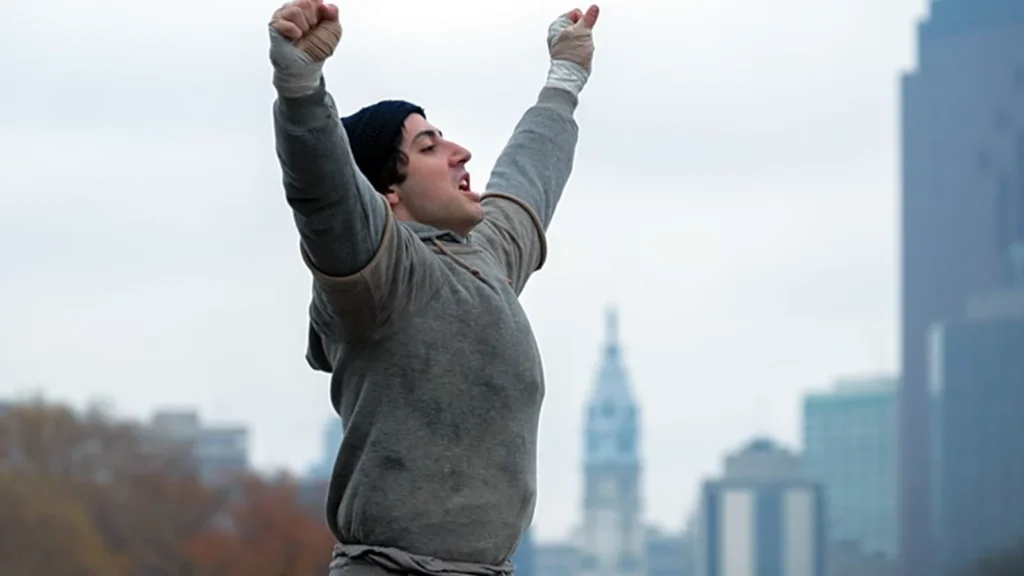
That collaborative perspective also clarifies the new film’s task. Recreating the making of Rocky involves depicting people at work, not merely reproducing famous images from the completed movie. A rehearsal, negotiation or production problem needs its own stakes within the scene. Recognition can provide context, but the new film must communicate why an apparently small decision mattered before anyone could know the eventual outcome.
Farrelly’s comments about recreating the 1970s address a practical difference between the two productions. The original filmmakers photographed their present day. The new production had to construct a convincing version of that period. In general filmmaking terms, that can require agreement among locations, costumes, props and camera framing. The panel does not supply an itemized account of every reconstruction, so those departments should be understood as the nature of the problem rather than a newly disclosed list of expenditures.
The project had already returned to Philadelphia for a special screening before Saturday’s discussion. Rachel Stone’s November 3 BroadwayWorld report identifies a November 2 event attended by Farrelly, Ippolito and Robb, among others. That is an earlier promotional milestone, not a new screening announcement. It does, however, place the current panel within an active theatrical campaign centered on a film closely associated with the city. [5]
Hogan’s TV Insider interview also identifies several performers recreating the original production team. P.J. Byrne plays producer Irwin Winkler, Toby Kebbell plays Robert Chartoff and Jay Duplass plays director John G. Avildsen. Stephan James portrays Carl Weathers, who played Apollo Creed. Those assignments create another layer of performance around Ippolito: actors portraying filmmakers and actors who were themselves building a fictional boxing world. The ensemble gives the making of the original film its own set of characters. [3]
Gamble’s presence on the panel adds another creative perspective to the project. A screenplay about the writing of a famous screenplay has two layers: the historical material being dramatized and the new structure used to make that material understandable. Compressing a development process requires choices about which obstacles and conversations carry the story. The existence of a real outcome does not remove the need to establish cause and effect for a viewer encountering the events for the first time.
The same consideration applies to Ippolito’s conversation with Stallone. A participant’s later recollection can provide an actor with intention, emphasis and emotional perspective. It remains a recollection, shaped by decades of looking back. The reported conversation is valuable evidence about Ippolito’s preparation; it is not independent confirmation that every scene in the dramatization occurred exactly as presented. Keeping those categories clear preserves the distinction between production reporting and historical documentation.
Saturday’s account is most useful when viewed at that human scale. Ippolito describes research becoming a conversation with the person he would portray, while Farrelly describes the constraints of getting the production made. Together, they add concrete context to I Play Rocky’s theatrical arrival: a performer preparing to inhabit an earlier moment in a famous career, and a filmmaking team trying to make the process of creating a classic into a story with its own dramatic life.
Sources and reporting credits
[1] Making I Play Rocky Felt Like a Throwback to 1976 for the Creators Contenders LA — Scott Huver, Deadline via Yahoo. November 14, 2026.
[2] How to Watch I Play Rocky the True Story Behind Rocky Out Now in Limited Theaters — Tyler Greenawalt, About Amazon. July 15, 2026; updated November 13, 2026.
[3] I Play Rocky: Anthony Ippolito Details the Extreme Prep to Play Sylvester Stallone — John Hogan, TV Insider. November 6, 2026 at 11:30 a.m. as displayed by the outlet.
[4] Rocky — AFI Catalog of Feature Films. Historical catalog entry for the 1976 film; accessed November 15, 2026.
[5] I Play Rocky Special Philadelphia Screening Draws Anthony Ippolito and AnnaSophia Robb — Rachel Stone, BroadwayWorld. November 3, 2026.
